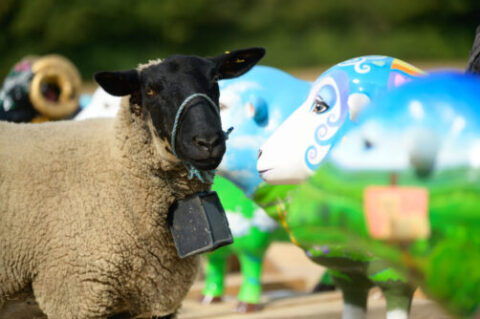
THE SURREY HILLS SHEEP PARADE
The Sheep Parade is an exciting initiative led by the Surrey Hills National Landscape team, delivered in partnership with local sheep farmers. The project celebrates the vital role sheep play in shaping and maintaining the landscape, while raising awareness of the importance of responsible dog ownership and encouraging people to keep dogs on leads around sheep.
A colourful flock of life-sized sheep sculptures, each uniquely decorated by a Surrey artist, will ‘parade’ across the Surrey Hills throughout the year. Designed to capture attention and spark conversation, these striking artworks will engage local communities and visitors while highlighting an issue that has a very real impact on farmers and animal welfare. Got a query? Email us at surreyhills@surreycc.gov.uk
THE SHEEP AT DENBIES: Grazing between the vines
The sheep sculptures may be new to Denbies, but sheep themselves aren’t. Since 2025, real sheep have been helping us manage the vineyard after harvest, grazing naturally between the rows as part of our approach to soil health and sustainable land management.
So when we talk about protecting the flock, it isn’t an abstract message for us. Sheep are now genuinely part of the working life of the estate
SHEEP WITH A MISSION
Denbies employs sheep as part of a more natural approach to vineyard management, with seasonal grazing helping to control weeds, improve soil health, reduce herbicide use and cut tractor movements, while providing valuable grazing for a local flock.
The project forms part of Denbies’ wider approach to reducing the environmental impact of wine production and finding practical ways for agriculture, wildlife and visitors to coexist across a working vineyard.
KEY FACTS
Introduced in 2025: The grazing project began in 2025 in partnership with local farmer Nick Bullen of A & N Bullen.
After-harvest grazing: Sheep are brought into areas between the vines after the grape harvest, when they can graze vegetation without interfering with the growing crop. In simple terms: once the grapes come out, the sheep can move in.
Natural weed management: Grazing helps control grass and weeds between the vine rows naturally, reducing reliance on mechanical management and helping to minimise herbicide use.
Healthier soils: As the sheep graze, they naturally return organic matter and nutrients to the soil through manure, while their movement also helps with soil aeration.
Fewer tractor movements: Using sheep for part of the vineyard’s vegetation management reduces the need for tractor passes, helping lower fuel use and the vineyard’s overall carbon footprint.
High-quality grazing: The partnership also provides the flock with useful seasonal grazing, creating a benefit for both the vineyard and the local farmer.
Local partnership: Rather than keeping its own flock, Denbies works with a local Surrey farmer, connecting vineyard management with the wider agricultural landscape around the estate.
Public access remains important: Sheep are securely fenced while grazing, with visitors and dog walkers asked to keep dogs on leads around livestock. Signage formed part of the original project.
265 acres under vine: Denbies has 265 acres of vineyard within its 380-acre estate in the Surrey Hills National Landscape. The sheep-grazing initiative sits within a much broader programme of nature-led land management across the estate.
HOW THE PROJECT WAS SUPPORTED
The trial was supported by the Surrey Hills National Landscape Farming in Protected Landscapes programme, funded by Defra.
The programme helps farmers and land managers deliver projects supporting nature recovery, climate resilience, sustainable farming and greater public understanding of protected landscapes.
At Denbies, funding helped provide the infrastructure needed for sheep to graze safely between the vines, including fencing and public signage. The project was developed in two phases between June 2025 and February 2026.
WHY IT MATTERS AT DENBIES
Sheep grazing is one practical part of a much larger sustainability programme at Denbies. The estate is the UK’s first vineyard and winery certified Net Zero under the UK Carbon Code of Conduct, is a Certified B Corp, a founder member of Sustainable Wines of Great Britain and received the King’s Award for Enterprise for Sustainable Development in 2025.